
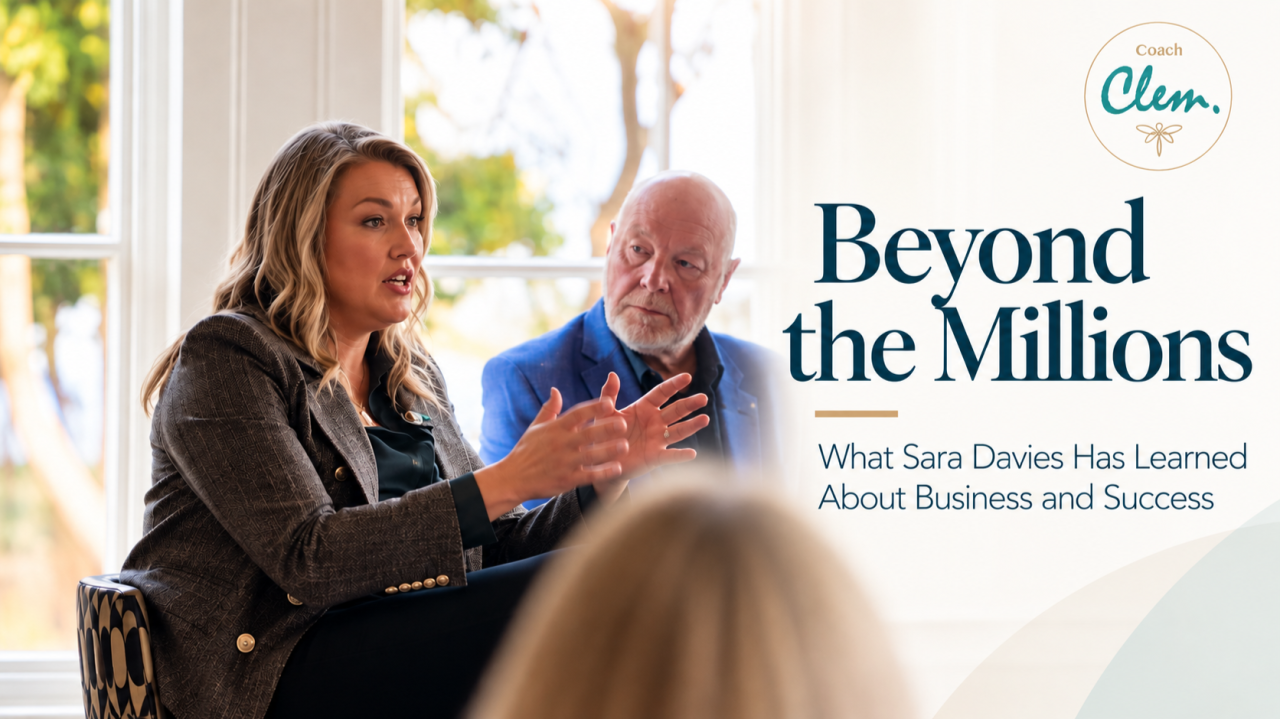
I attended one of the most insightful, inspiring and thought-provoking business events I’ve been to in a long time, and I’m still buzzing from the experience.
Strategy That Scales, held at Seaham Hall on 8 October, brought together three people with different but complementary perspectives on entrepreneurship.
Sara Davies, founder of Crafter’s Companion, entrepreneur, investor and well-known television personality, shared her experiences of building and scaling a multi-million-pound business, alongside the personal lessons she’s learned throughout her journey.
Ian Kinnery, business and scale-up coach, brought his experience of working with business owners, offering a wider perspective on the challenges of growth, leadership and the decisions founders face along the way.
The event was organised and hosted by Paul Card, of Paul Card Recruitment, who brought everyone together for a conversation about sustainable business growth.
What made the event particularly powerful was the combination of Sara’s openness about her personal and professional journey and Ian’s ability to put those experiences into a wider business context.
I was genuinely amazed by how vulnerable, honest and real Sara was. She shared not only her successes, but also the challenges, mistakes and difficult choices that have shaped her as a business owner and investor.
And what stayed with me most was how much of this conversation about scaling businesses was actually about mindset, self-awareness, emotions, personal growth and understanding what truly matters.
When growth becomes the goal
One of the most striking examples Sara shared was about the growth of her own business.
At one stage, Crafter’s Companion had reached £10 million in turnover and £1 million in profit. The business continued to expand, eventually reaching £36 million in turnover, but with profits of only £1.5 million.
What was particularly interesting was how she described the increasing complexity of running a business at that scale.
As both Sara and Ian explained, the challenges don’t simply increase in proportion to the size of the business. They multiply. More people, more operations, more decisions, more responsibilities and more things that can go wrong.
In this case, the business had become significantly more complex to manage, without generating a proportionate increase in profitability.
And it raises an important question: What are we actually growing for?
Growth is often presented as an obvious measure of success. Bigger turnover, more employees, more markets, more opportunities. But how often do we stop to question whether that growth is taking us closer to what we actually want?
Sara reflected on how easy it can be to find yourself pursuing growth for the sake of growth, without necessarily recognising it at the time.
What I particularly appreciated was her perspective on the mistakes and challenges she’d experienced along the way. She was very clear that these experiences had been some of her greatest teachers and had helped her become a better business owner and investor.
I think there’s something important here that applies well beyond entrepreneurship. We can understand certain things intellectually, we can listen to advice and learn from other people’s experiences, but there are lessons we only truly grasp once we’ve lived through them ourselves.
And perhaps that’s part of the challenge of entrepreneurship. We need to be willing to learn through experience, including the difficult parts, while developing enough self-awareness to recognise what those experiences are teaching us.
The soul of the business
Throughout the conversation, Ian referred to something that particularly resonated with me: the soul of the business.
For me, this is the deeper why. The things you cannot compromise on, the things that make your business unique, the reason why this particular business makes you sing.
It’s something I feel very strongly about, both as an entrepreneur myself and in my work coaching other business owners.
But of course, there is also the operational reality of running a business. We operate in a real market, with financial responsibilities and practical constraints. Businesses need to be profitable, shareholders need a return, employees need sustainable jobs and customers need products or services that deliver real value.
There is absolutely nothing wrong with wanting to make money, and nothing to be ashamed of. Profit is an essential part of building a sustainable business.
The challenge is finding that fine balance between protecting the soul of the business and responding to its commercial reality.
Because if we focus exclusively on the financial side, we risk losing sight of what made the business meaningful in the first place. But if we focus only on the vision, without taking the commercial realities seriously, we risk undermining the very business we’re trying to build.
And I think this is where the founder’s personal journey becomes particularly important.
The fine dance between the founder and the business
Sara talked about how, when she works with entrepreneurs she invests in, she pays close attention to their personal circumstances, ambitions and motivations.
Because there are different agendas at play, and they don’t always naturally align.
There’s the founder’s agenda, which is deeply personal.
Where are they in their life? What do they want to achieve? What does success mean to them? What are their family circumstances, their financial needs, their ambitions and their priorities?
And what does their current reality allow?
These are questions I explore all the time in my own coaching work, because the business someone wants to build cannot be separated from the life they want to live.
Then there’s the business agenda, with its financial responsibilities, market conditions, operational requirements and expectations from investors, directors and other stakeholders.
Both matter, and both need attention.
I kept thinking about this relationship as a dance, a constant movement between the founder’s vision and the commercial reality of the business.
The founder is often the driving force, bringing the original idea, the energy, the creativity and the deeper reason for building the business. But as the business grows, it develops needs and responsibilities of its own.
And that’s where having the right people around you becomes so valuable.
People who can understand both perspectives, who can challenge the founder without losing sight of their vision, and who can help bridge the gap between personal ambitions and business requirements.
I think that’s a particularly important role for coaches, mentors and the right investors.
Developing the founder, not just growing the business
Sara described two different types of investors she’d encountered.
Some are happy to provide the capital, take their seat at the board table and remain relatively hands-off.
Others become much more involved, bringing ideas, challenging decisions, supporting the founder and helping them develop the skills required to take their business further.
What I particularly connected with was this mentoring aspect.
Because growing a business also requires the founder to grow, and that involves a much wider range of skills than we sometimes recognise.
Of course, there are the commercial skills: understanding markets, developing sales strategies, learning how to expand internationally, delegating effectively and building the right operational structures.
But there are also the skills that relate to how we understand and manage ourselves.
The ability to recognise when we’re getting in our own way, to receive hard, honest and sometimes uncomfortable feedback, to say no to opportunities that aren’t right, and to accept a no from others, particularly when we’re full of ideas and possibilities.
The ability to recognise our own limitations, manage our emotions, question our assumptions and develop the judgement needed to become a true leader.
These are often described as soft skills, a term I’ve never particularly liked.
Because there’s nothing soft about them. In many ways, they are some of the deepest, most challenging and most important capabilities we can develop.
And I loved how strongly this came through in the conversation.
It’s almost like the yin and the yang coming together. The commercial and the personal, the practical and the emotional, business strategy and self-awareness.
For me, this is deeply connected to Self-Harmonising, the work of understanding who we truly are, recognising what shapes our choices and learning to build from a place of greater awareness and alignment.
And there’s another important aspect to supporting founders that Sara illustrated beautifully.
She described her role as an investor and mentor using the analogy of being an auntie rather than a mother.
She can support the founder, offer guidance, challenge them and get excited about their progress, but at the end of the day, she can give the baby back and go home.
I loved that analogy because it captures something fundamental about helping others grow.
The founder needs to remain responsible for their own business, make their own decisions and learn through their own experiences. Just as you don’t learn to parent by having someone else do the parenting for you, you don’t develop as a business owner by having someone else make all your decisions.
And this is where the role of a good coach, mentor or investor becomes so valuable. They can offer perspective, ask difficult questions, share their experience and help the founder develop their own capabilities, while leaving them with the ownership and responsibility that ultimately belong to them.
What happens when you no longer need more?
Another part of Sara’s story that really stayed with me was her reflection on what motivates her today.
She’s reached an extraordinary level of financial and professional success. She’s built a multi-million-pound business, become a well-known public figure and developed a career as an investor.
She’s reached a point where she doesn’t really need more for herself, and she’s increasingly conscious of protecting her time, her balance and the things that genuinely excite her.
But that doesn’t mean life has become simple or that difficult choices have disappeared.
She shared that she’d landed from the US at midday and was at Seaham Hall by 4 pm, which meant missing the opportunity to pick up her boys from school after having already been away for several days.
As a mother, I could really relate to that. A few days away can feel like a long time, and those choices between professional commitments and family life don’t necessarily become easier with success.
Complexity is still there, even if it takes a different form.
What I found particularly interesting, though, was what Sara said about her deeper motivation at this stage of her life.
She wants to help others.
She gets genuinely excited about supporting entrepreneurs and helping them achieve their dreams. And because she’s supporting someone else’s vision rather than building another business entirely for herself, she can be involved without carrying the same level of personal attachment and responsibility.
That brought me back to the analogy of being the auntie rather than the mother, but also to a much bigger question.
When we’ve reached a place where we no longer need more for ourselves, does our motivation naturally shift towards the impact we can have on others?
Towards contributing, supporting and helping others achieve what matters to them?
And perhaps an even more interesting question is whether we actually need to reach that level of financial success before we can live and work from that place.
Can impact, contribution and helping others achieve their dreams be central to our work even when we’re still building, growing and dealing with our own financial realities?
I think there’s something worth exploring here, particularly in relation to how we define success and what we allow ourselves to prioritise along the way.
Coming back to what truly matters
I left this event with so much to reflect on.
And what surprised me, although perhaps it shouldn’t have, was just how much of the conversation about scaling businesses was really about people.
Their motivations. Their fears. Their blind spots. Their ability to learn, grow, lead and make difficult decisions.
And the constant balancing act between what we want to build and the life we actually want to live.
There is no escaping the commercial realities of running a business, nor should we want to.
But there is something incredibly important about remaining conscious of why we’re doing what we’re doing.
About protecting what matters, while being willing to learn, adapt and grow.
About recognising that building a business will continually ask us to develop, not only our business skills, but ourselves.
And about remembering that success isn’t necessarily about having more.
Perhaps it’s also about having the freedom, the awareness and the courage to choose what truly matters.
That’s the kind of entrepreneurship I believe in.
And it’s at the heart of Self-Harmonising: building a business and a life that truly fit.
A huge thank you to Sara Davies for being so open and generous with her experiences, to Ian Kinnery for bringing such valuable perspectives, and to Paul Card for organising a conversation that will stay with me for a long time.


